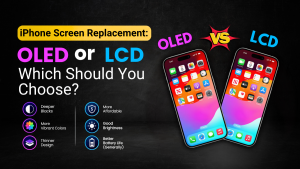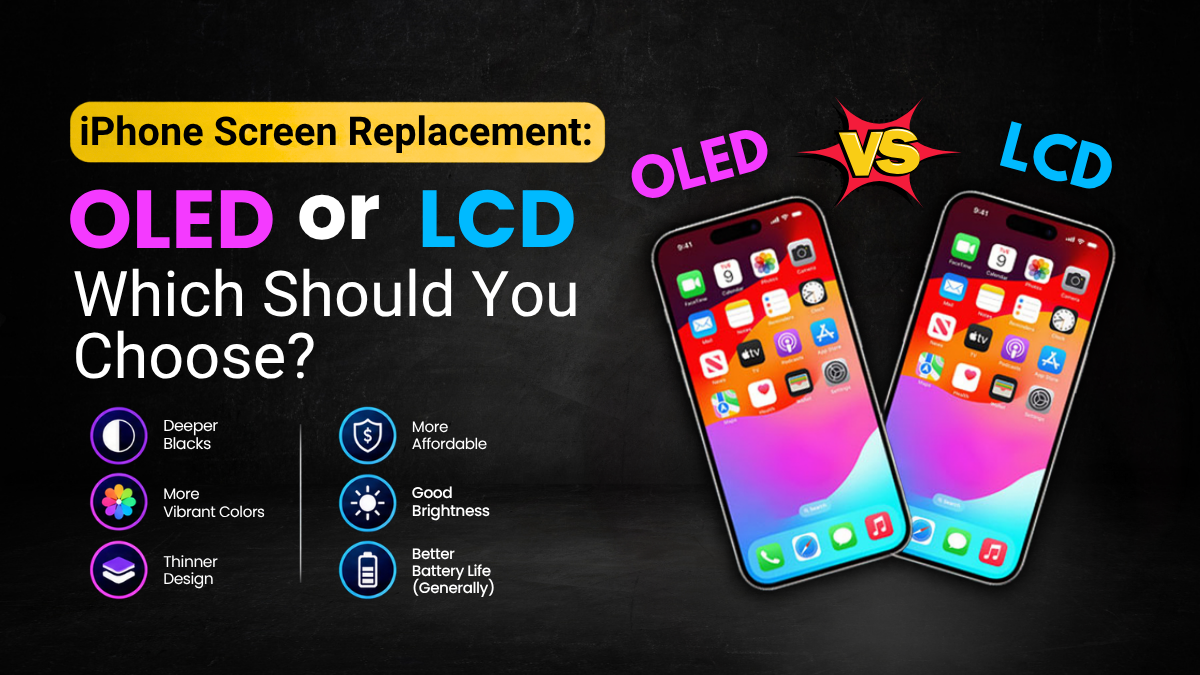
Before you choose the cheapest screen, here’s what OLED vs LCD really means for your iPhone.
Cracked your iPhone screen and suddenly been asked whether you want OLED or LCD? The cheaper option can sound attractive, but your choice can affect far more than the repair bill. Display quality, black levels, brightness, colour accuracy, touch response, screen thickness and even power behaviour can differ depending on the replacement screen fitted to your iPhone.
When choosing an iPhone screen replacement, you should consider the technology your iPhone originally used, the quality of the replacement panel, your budget and how you normally use your phone. OLED generally delivers deeper blacks, stronger contrast and display characteristics closer to an OLED-equipped iPhone, while a compatible LCD replacement can provide a more affordable option when budget matters most.
At Gadgets N Repair, we believe customers should understand what they are paying for before choosing a replacement. This guide explains OLED vs LCD, Soft OLED, Hard OLED, Incell LCD and other common screen grades so you can make a more informed decision.
iPhone Screen Replacement OLED or LCD: What’s the Difference?
OLED and LCD are two different display technologies. OLED stands for Organic Light-Emitting Diode, while LCD means Liquid Crystal Display. Both can produce a clear and usable smartphone display, but they create the image in very different ways.
An OLED screen contains pixels that produce their own light. An LCD screen uses liquid crystals with a backlight behind the display. This fundamental difference influences black levels, contrast, screen construction, brightness behaviour and potentially power consumption.
Here is a simple comparison before we look at each technology in more detail.
| Feature | OLED | LCD |
|---|---|---|
| Display technology | Self-emitting pixels | Liquid crystals with backlight |
| Black levels | Deep/true blacks | Backlit blacks |
| Contrast | Higher | Generally lower |
| Colour | Vibrant | Good everyday colour |
| Construction | Can be thinner | Often thicker |
| Power behaviour | Individual pixels illuminate | Backlight illuminates display |
| Replacement price | Usually higher | Usually lower |
| Typical appeal | Display quality | Lower repair cost |
However, simply asking whether a screen is OLED or LCD does not tell you everything about its quality. Modern replacement screens may also be described as Soft OLED, Hard OLED, Incell LCD, aftermarket, refurbished original or genuine, and quality can vary within those categories.
What Is an OLED iPhone Screen?
OLED stands for Organic Light-Emitting Diode. Unlike an LCD panel, OLED does not need a traditional full-screen backlight because every individual pixel can generate its own light. When an OLED display needs to show black, those pixels can effectively switch off rather than trying to block light coming from behind them.
This pixel-level control gives OLED its well-known deep blacks, high contrast and vibrant image quality. OLED panels can also use thinner display constructions, which helps create the slim appearance associated with newer smartphones. The technology is particularly attractive for photography, video, gaming, streaming and other situations where display quality matters.
Apple began introducing OLED displays into the iPhone range with premium models such as the iPhone X and has since expanded the technology across newer generations. If your iPhone originally shipped with OLED, choosing an OLED replacement can therefore help preserve more of the display characteristics you are accustomed to.
What Is an LCD iPhone Screen?
LCD stands for Liquid Crystal Display. Instead of every pixel producing its own light, an LCD uses a backlight positioned behind a liquid-crystal layer. The display controls how much of that light passes through to create the colours and images you see.
LCD technology has been used successfully in many iPhones, including models such as the iPhone XR and iPhone 11. It can provide good brightness and reliable everyday performance for browsing, messaging, social media and general app use. LCD replacement screens can also be more affordable, making them attractive when keeping the iPhone screen repair cost down is the main priority.
The main difference becomes more noticeable when an LCD replacement is considered for a phone originally designed around OLED. Because LCD uses a backlight, it cannot reproduce pixel-level black in exactly the same way as OLED, and characteristics such as contrast, thickness, viewing behaviour and power use may differ.
OLED vs LCD Screen Quality: What Will You Actually Notice?
The technical difference between OLED and LCD is useful to understand, but most customers really want to know what they will notice after their iPhone screen replacement. Display technology can influence several parts of the everyday experience, although the quality of the individual replacement panel remains extremely important.
A premium replacement screen and a very cheap replacement using the same broad technology label may perform differently. For this reason, screen grade, manufacturer, compatibility and installation quality should be considered alongside OLED versus LCD.
Colour Depth, Black Levels and Contrast
OLED has a clear technical advantage when displaying black because individual pixels can switch off. This creates much deeper blacks and strong contrast between bright and dark parts of an image. The difference can be particularly noticeable when watching films, viewing photographs or using apps with dark interfaces.
LCD screens use a backlight, so dark areas are produced by controlling the light passing through the panel rather than switching individual pixels off. A good LCD can still produce an attractive image, but black levels and contrast will generally behave differently from OLED.
Colour accuracy is also affected by the quality and calibration of the replacement screen. A screen being labelled OLED does not automatically mean its colours will perfectly match the original Apple display.
Brightness and Outdoor Visibility
Brightness is another important consideration, especially if you regularly use your iPhone outdoors. Both OLED and LCD screens can produce usable brightness, but performance varies between individual panels, manufacturers and replacement grades.
A low-quality replacement may have lower maximum brightness or inconsistent brightness compared with the original display. Therefore, customers should avoid assuming that every OLED replacement will automatically outperform every LCD replacement simply because of the underlying technology.
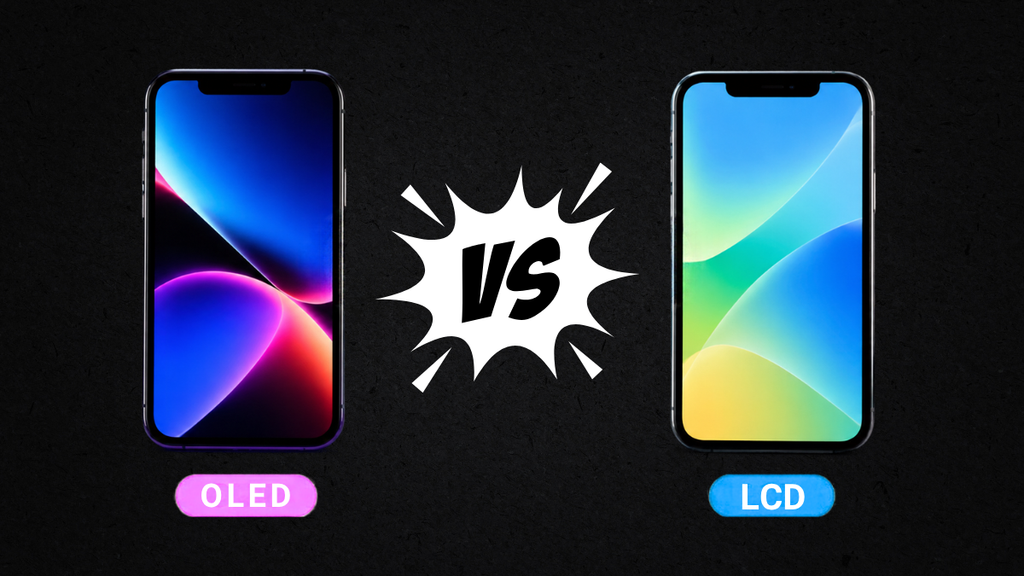
When comparing screen options, ask about the actual part being fitted, not just whether it is OLED or LCD.
Touch Response and Everyday Performance
Your display also contains the interface you use to control almost everything on your iPhone, so touch response matters just as much as picture quality. Typing, scrolling, gaming, browsing and switching between apps all depend on accurate and consistent touch behaviour.
Good-quality replacement screens should provide reliable everyday touch performance. However, the response can vary between replacement grades, particularly when comparing very inexpensive aftermarket panels with better-specified alternatives.
For someone who frequently games or uses high-performance apps, smooth touch response and display behaviour may therefore justify paying closer attention to screen quality rather than choosing solely on price.
Screen Thickness and Viewing Angles
OLED technology can allow thinner display construction because it does not require the same backlighting system as LCD. Soft OLED in particular uses a flexible substrate, while Hard OLED generally uses a more rigid substrate. These construction differences can influence thickness, fit and physical behaviour.
Viewing angles can also differ between panels. A better-quality screen should remain clear and consistent when viewed from different angles, whereas some lower-grade replacement displays may show more noticeable changes in brightness or colour.
These details may sound minor, but together they influence how close a replacement feels to the display you were using before the screen was damaged.
Battery Life and Power Consumption
OLED and LCD consume power differently. OLED pixels illuminate individually, meaning darker content can require less pixel illumination. LCD, by comparison, relies on a backlight that operates behind the display.
That does not mean installing any OLED replacement will automatically improve your iPhone’s battery life. Screen brightness, replacement-panel quality, battery health, applications, settings and everyday usage all contribute to actual battery performance.
If your iPhone is already losing charge unusually quickly, the display may not be the only issue. In that situation, having the battery checked alongside the screen repair can help determine whether a battery replacement is also worth considering.
Soft OLED vs Hard OLED vs Incell LCD: Understanding Screen Grades
One area many basic OLED vs LCD guides overlook is screen grade. When you receive an iPhone repair quote, you may hear terms such as Soft OLED, Hard OLED, Incell LCD, aftermarket OLED, refurbished original or genuine display. Understanding these terms makes it much easier to understand why two repair shops can quote very different prices for what appears to be the same screen replacement.
Soft OLED and Hard OLED both use OLED technology, while Incell replacements are generally LCD-based. Current repair-industry guides also caution that these labels describe broad construction categories rather than guaranteeing that every part carrying the same label will have identical brightness, touch response, durability or colour accuracy.
What Is Soft OLED?
Soft OLED generally refers to an OLED display built on a flexible substrate. This flexible construction is closer to the type of OLED structure used in many modern premium smartphones and allows the panel to remain relatively thin.
Soft OLED is often positioned as a premium aftermarket option because customers can retain OLED characteristics such as deep blacks and strong contrast while getting a flexible display construction. It can be particularly attractive for people who own a higher-value OLED-equipped iPhone and care about maintaining a display experience closer to the original.
However, Soft OLED should not automatically be confused with a genuine Apple display. It describes the panel construction, and actual quality can still vary between manufacturers and suppliers.
What Is Hard OLED?
Hard OLED also uses self-emitting OLED pixels but generally places the OLED stack on a rigid substrate rather than the flexible construction associated with Soft OLED. It can therefore provide true OLED-style black levels and contrast while being positioned as a more cost-conscious OLED replacement.
For someone who wants OLED display characteristics but does not want to pay for a higher-priced replacement option, Hard OLED can represent a middle ground. However, construction, thickness, brightness and durability can vary, so the exact screen specification still matters.
Current competitors in the replacement-screen market consistently separate Hard OLED from Soft OLED rather than treating all aftermarket OLED screens as one quality level.
What Is Incell LCD?
Incell is commonly used in the repair market to describe an LCD replacement where the touch-sensing layer is integrated more closely into the display assembly. It remains LCD technology and therefore still uses a backlight.
Incell LCD can be a sensible choice for phones that originally used LCD technology and can also appear as a lower-cost replacement option for some repairs. Its biggest attraction is generally affordability while still providing practical performance for everyday browsing, calls, messaging and apps.
On an OLED-equipped iPhone, however, an Incell LCD does not reproduce OLED’s pixel-level blacks and contrast. Current repair-industry guidance also notes that thickness, brightness, viewing behaviour, touch and power characteristics can vary depending on the exact replacement.
Soft OLED vs Hard OLED vs Incell LCD: Quick Comparison
Understanding the differences becomes much easier when the three common aftermarket categories are placed side by side.
| Screen Type | Technology | Construction | Main Advantage | Common Consideration |
|---|---|---|---|---|
| Incell LCD | LCD | Backlit LCD assembly | Lower cost | Different from OLED |
| Hard OLED | OLED | Rigid substrate | OLED contrast at a lower price point | More rigid construction |
| Soft OLED | OLED | Flexible substrate | Closer OLED construction | Usually costs more |
| Original/refurbished | Original panel technology | Original panel retained/reworked | Closer to original characteristics | Higher cost/availability |
The important point is that these are categories rather than universal quality scores. Two Soft OLED screens from different manufacturers can perform differently, just as two Incell replacements may not have identical brightness, touch response or durability.
Original vs Aftermarket iPhone Screens
Another common source of confusion is the word “original”. An OLED screen is not automatically an original Apple screen simply because it uses OLED technology. Likewise, Soft OLED and Hard OLED are commonly used aftermarket repair terms and should not automatically be interpreted as genuine Apple parts.
A refurbished original screen generally refers to an original display panel that has been retained while damaged outer components, commonly the glass, have been replaced during refurbishment. A genuine Apple part follows Apple’s own parts and repair ecosystem. These options can therefore sit at different price points from standard aftermarket LCD or OLED screens.
When comparing repair quotes, ask exactly what is being supplied. Terms such as “premium”, “OEM quality” or “original quality” can be vague unless the repair provider explains the actual screen type and source.
Can You Replace an OLED iPhone Screen With LCD?
Aftermarket LCD replacements are available for some repairs involving phones that originally used OLED, but changing the underlying display technology means you should not expect the replacement to behave exactly like the original OLED panel.
An LCD uses a backlight, whereas OLED illuminates individual pixels. As a result, black levels, contrast, thickness, viewing behaviour and power characteristics may differ. Whether those differences matter depends largely on your expectations, the quality of the replacement and how you normally use the phone.
If you mainly use your iPhone for calls, messaging and browsing and want to minimise repair cost, a compatible budget option may be worth discussing. If display quality, gaming, photography, video or maintaining OLED-style characteristics matters more, an appropriate OLED replacement may make more sense.
At Gadgets N Repair, our iPhone screen repair in St Helens service can help customers understand the available options for their particular device before proceeding with a repair.
Which iPhone Models Use OLED and Which Use LCD?
Knowing what technology your iPhone originally used gives you a much better starting point for choosing its replacement. Apple has used both LCD and OLED displays across different generations, so you should not assume every iPhone uses the same screen technology.
| iPhone Model | Original Display Technology |
|---|---|
| iPhone X | OLED |
| iPhone XS / XS Max | OLED |
| iPhone XR | LCD |
| iPhone 11 | LCD |
| iPhone 11 Pro / Pro Max | OLED |
| iPhone 12 series | OLED |
| iPhone 13 series | OLED |
| iPhone 14 series | OLED |
| iPhone 15 series | OLED |
| iPhone 16 series | OLED |
This is particularly useful when comparing replacement quotes. If your phone originally used OLED and one quote is dramatically cheaper than another, check whether both businesses are actually quoting the same screen technology and grade.
What About True Tone, Face ID and Display Features?
Modern iPhone displays work alongside several hardware and software features, so screen replacement involves more than simply producing an image. True Tone, automatic brightness, touch behaviour, sensors and other display-related functions can be relevant depending on the model and repair process.
Face ID itself is a separate biometric system, but sensitive components around the display assembly need to be handled correctly during repair. This is one reason an experienced iPhone repair service should follow appropriate procedures when replacing the screen rather than treating the job as a simple panel swap.
Owners of Pro models should also ask about refresh-rate support where relevant. If you value smooth scrolling, gaming or other high-performance display behaviour, confirm what the replacement panel actually supports instead of assuming every aftermarket screen reproduces every feature of the original.
How Much Does OLED vs LCD iPhone Screen Replacement Cost?
OLED replacement screens generally cost more than LCD alternatives because the technologies and screen constructions differ. However, there is no single OLED or LCD repair price because the final cost depends on the iPhone model, replacement grade, manufacturer, part availability, labour and warranty.
Soft OLED will commonly sit at a different price point from Hard OLED, while Incell LCD is frequently positioned as a more budget-conscious option. Original or refurbished-original displays may carry another price level again. This variety explains why customers can receive noticeably different quotations for what initially sounds like the same repair.
Instead of asking only for the cheapest phone screen repair, ask what screen grade is included in the quoted price. Comparing an Incell LCD quote against a Soft OLED or original-panel quote without considering the part type does not provide a fair comparison.
Is OLED Worth the Extra Cost for iPhone Screen Replacement?
OLED can be worth paying more for when you own an iPhone originally equipped with OLED and care about deep blacks, strong contrast, display thickness and overall visual quality. It may also make more sense if you regularly use your phone for photography, video, gaming or streaming and intend to keep the device for several more years.
LCD can be a practical choice when affordability matters more and a compatible replacement is available. For an older device or a phone used primarily for messaging, browsing and everyday apps, paying significantly more for a premium screen may not always fit the customer’s priorities.
The decision should therefore consider the phone’s age and value alongside repair cost. The most expensive screen is not automatically the right choice for every customer, just as the cheapest screen is not automatically the best value.
Which iPhone Replacement Screen Should You Choose?
Start with your exact iPhone model and identify the technology it originally used. Then compare the available replacement grades, including LCD or Incell, Hard OLED, Soft OLED and original/refurbished options. Ask what the fitted price includes and whether the repair comes with a warranty.
If maintaining OLED-style display quality is your priority, an appropriate OLED replacement is generally the more relevant option for an OLED-equipped phone. If your priority is reducing repair cost and a compatible LCD option is available, LCD may provide a practical alternative as long as you understand the display differences.
Most importantly, do not choose based only on labels. Compatibility, panel quality, brightness, touch response, screen construction, installation and warranty all contribute to whether a replacement is suitable.
iPhone Screen Replacement in St Helens
A cracked screen, damaged display or unreliable touchscreen can make an otherwise perfectly usable iPhone frustrating to use. Choosing the correct replacement can help you avoid paying for display characteristics you do not need while also preventing disappointment from choosing a screen purely because it was the cheapest option available.
At Gadgets N Repair, our iPhone screen replacement in St Helens service helps customers understand the available repair options for their device. Your iPhone model, original display technology, budget and everyday usage should all be considered before choosing between OLED, LCD or another replacement grade.
Gadgets N Repair also provides phone repair services in St Helens for other common hardware problems. If the screen issue is accompanied by poor battery performance, charging problems or another fault, having the device properly assessed can help identify what actually needs repairing rather than replacing parts unnecessarily.
FAQs
Is OLED or LCD better for iPhone screen replacement?
OLED generally provides deeper blacks, stronger contrast and display characteristics closer to an iPhone that originally used OLED. LCD can provide a more affordable repair option when a compatible replacement is available. However, the quality and specification of the actual replacement screen matter just as much as the technology label.
Can I replace an OLED iPhone screen with an LCD?
LCD-based aftermarket replacements are available for some repairs involving OLED-equipped phones. However, LCD and OLED work differently, so black levels, contrast, thickness, viewing behaviour and power characteristics may not be identical to the original display.
What happens if I put an LCD screen on an OLED iPhone?
The phone may still provide a usable display if the replacement is specifically compatible, but the screen will use LCD technology rather than OLED. That means it will rely on a backlight and may look or behave differently in areas such as black levels, contrast, brightness and thickness.
How can I tell whether my iPhone screen is OLED or LCD?
Start by identifying your exact iPhone model and checking the original display specification. Models such as the iPhone XR and iPhone 11 originally used LCD, while the iPhone X, XS, 11 Pro and iPhone 12 and later mainstream families moved extensively towards OLED.
What is the difference between Soft OLED and Hard OLED?
Both use OLED technology, but Soft OLED generally uses a flexible substrate while Hard OLED uses a rigid substrate. Soft OLED is commonly positioned as a higher-grade aftermarket option, while Hard OLED can provide OLED characteristics at a lower price point. Actual quality still varies between manufacturers.
Is Incell the same as OLED?
No. Incell replacements in the independent repair market are generally LCD-based. They use a backlight, whereas OLED pixels generate their own light. The technologies therefore differ in areas such as black levels, contrast and construction.
Is Soft OLED close to an original iPhone screen?
Soft OLED’s flexible construction can be closer to the type of OLED structure used in many modern premium phones, but the term does not mean the screen is genuine Apple. Manufacturer, panel quality, calibration and other specifications still need to be considered.
Does replacing OLED with LCD affect battery life?
OLED and LCD use power differently, so changing display technology can alter power behaviour. However, actual battery life also depends on screen brightness, battery condition, applications, settings and the quality of the replacement panel.
Will screen replacement affect True Tone?
True Tone behaviour can depend on the replacement part and repair process. If retaining True Tone is important to you, ask the repair provider what to expect for your exact iPhone model before approving the repair.
Will iPhone screen replacement affect Face ID?
A screen replacement does not automatically mean Face ID will stop working because Face ID is a separate system. However, components around the display assembly require careful handling, which makes correct repair procedures important.
Does an aftermarket iPhone screen support 120Hz ProMotion?
Support depends on the exact replacement screen and iPhone model. If your original display has a high refresh rate or ProMotion and this feature matters to you, confirm the replacement-panel specification before booking the repair.
Why is an OLED replacement more expensive than LCD?
OLED panels use different display technology and manufacturing processes from LCD. The price can also vary according to whether you choose Hard OLED, Soft OLED, original/refurbished or another screen grade, as well as the particular iPhone model.
Is a cheap iPhone replacement screen worth it?
It depends on what screen is actually being supplied. A lower-cost repair can make sense for an older device or a budget-conscious customer, but you should know whether the quote covers Incell LCD, Hard OLED, Soft OLED or another replacement type and what warranty is included.
Where can I get an iPhone screen replacement in St Helens?
Gadgets N Repair provides iPhone screen repair in St Helens for customers with cracked, damaged or faulty displays. Ask about the available replacement-screen grades for your specific iPhone so you can compare the repair based on technology, quality and price rather than price alone.
Final Thoughts
Choosing an iPhone screen replacement OLED or LCD is not simply a question of which one costs less. OLED provides pixel-level illumination, deeper blacks and strong contrast, while LCD uses a backlight and can offer a more budget-conscious replacement route. For many customers, the right decision depends on how closely they want the repaired phone to resemble the display experience they had before the damage.
You should also look beyond the basic OLED-versus-LCD comparison. Soft OLED, Hard OLED, Incell LCD, original and refurbished-original displays can all appear when comparing repair options, and those labels describe different constructions rather than guaranteeing identical quality. Screen brightness, colour accuracy, viewing angles, touch response, thickness, compatibility, refresh-rate support and warranty are all worth considering.
Before booking an iPhone screen replacement, identify your exact iPhone model, find out what display technology it originally used and ask what screen grade will actually be installed. For customers in St Helens, Gadgets N Repair can explain the available options and help you choose a repair that balances display quality, everyday use and budget.